

Your school, with a room for every class
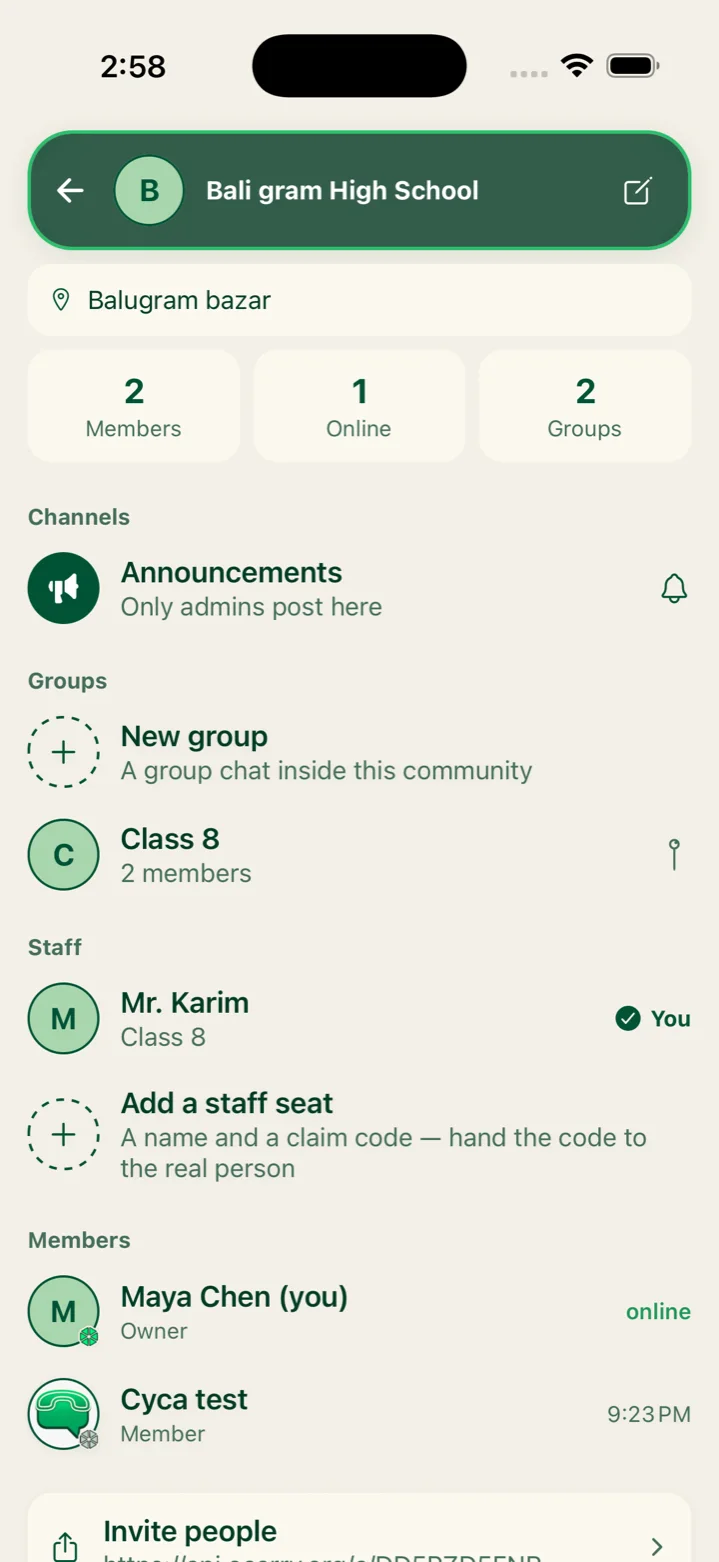
A community used to be a room with people in it. That was enough for a group of friends and not nearly enough for a school, which is the thing people kept trying to build with it.
The work was never the chatting
Watch anyone run a school on a chat app and the same three problems show up. Somebody has to build Class 8 by hand every year. Somebody has to know which of the four Rahims is in it. And every parent who arrives asks the same question — is this the real one?
None of that is a messaging problem. It is an admissions problem, an identity problem and a roster problem, and they are now handled in the product instead of by one exhausted person with a contacts list.
Classes are rooms
A school is created with its classes named at the same time. Each becomes a real room inside the school, with its own members, its own count and its own admin. The school room stays the school room — notices, everybody. A class room is the thirty people it concerns.
Students ask at the class door and say who they are, usually a roll number. The request appears under that class on the teacher's phone. They approve, and the student is in. The decision is made by the person who actually knows the answer.
A teacher's seat, and the code that unlocks it
The staff list is written before the staff arrive. "Mr. Karim — Class 8" exists as a seat whether or not Mr. Karim has ever opened Cyca. Each seat carries an eight-character code that only an admin can see.
Mr. Karim opens the school, finds his own name, taps This is me, types the code — and the seat is his, along with admin of the class that matches his title. The code then stops working. No promoting people by hand, no guessing who a message is from, and no group where everyone is an admin because it was easier that way.
The alphabet those codes are drawn from has no I, no L, no O and no U, so nothing in a code can be misread off a whiteboard or down a phone line.
An organisation face
Pick Business or NGO instead and the community grows the things somebody needs before they trust you: an address, a contact number that gets answered, as many named email contacts as you like — "Maggie, alumni", "admissions", "accounts" — and your websites. One info@ address is where most messages go to die.
And a tick that means something
Any community that is not a personal room can ask to be verified. We freeze the page exactly as it was submitted, and a person reads it — with the snapshot and the live page side by side, so a case cannot be won by editing the page afterwards. If something is missing we ask for it instead of rejecting you for it.
The answer lands in your chats, in a conversation called Cyca Verification: the request, any follow-up question, and the decision, each as a card you can go back and read.
A tick says this community is who it says it is. It is not an endorsement, and it can come off again if the room stops being what was verified. The whole thing is written up here.